
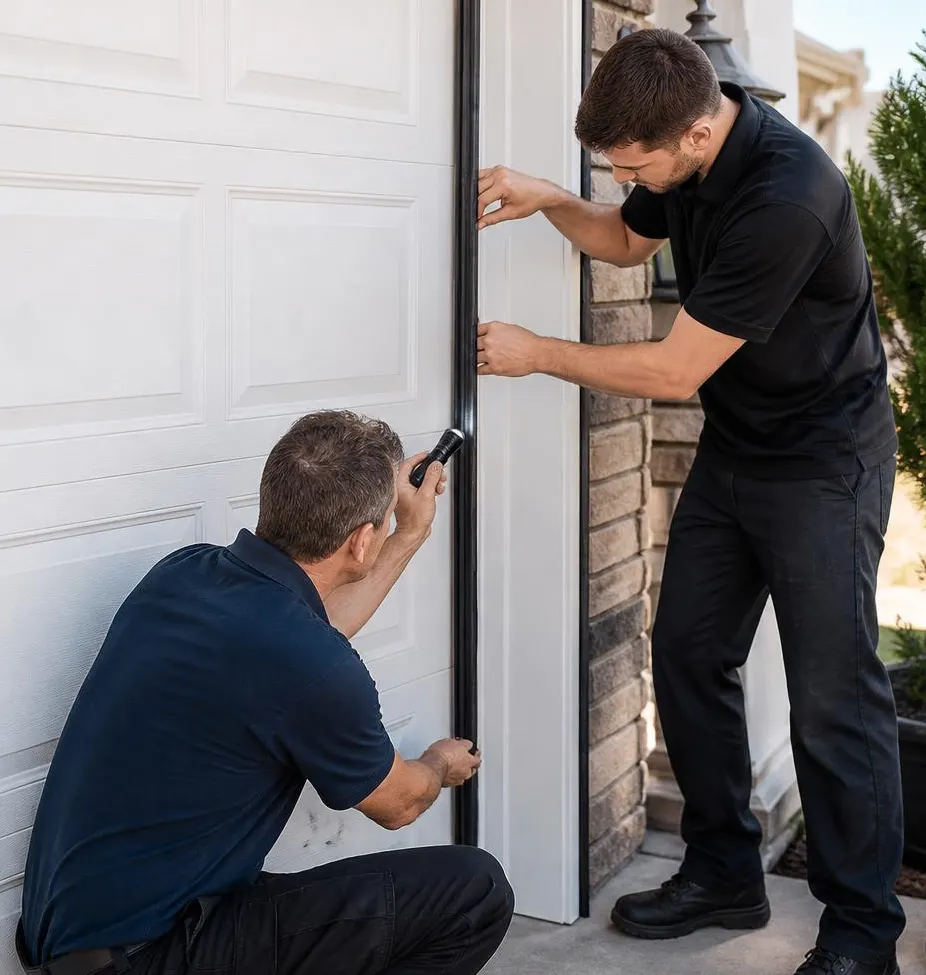
Most photo-eye sensor problems come down to dust, misalignment, or glare — not a failed part. Before you assume you need a new sensor or opener board, clean the lenses, check alignment, and clear anything sitting in the beam path. That fixes the problem more often than not.
What the Photo-Eye Sensors Actually Do
Every garage door opener made in the last few decades has two small sensors mounted a few inches off the floor on either side of the track. One sends an infrared beam, the other receives it. As long as that beam is unbroken, the door can close normally. If something — or someone — crosses the beam, the door is supposed to stop and reverse. It's the single most important safety feature on the system, and it's also one of the most sensitive to dirt, bumps, and weather.
Why They Trip or Stop Working
- Dust and pollen film on the lenses — long hot stretches with little rain mean dust and pollen build up fast on the small glass or plastic lens covers, especially in garages with the door open often.
- Spiderwebs and insects — a single strand across a lens is enough to scatter the beam.
- Knocked-out-of-alignment brackets — a bumped bike, a lawnmower, a car door, or a sudden gust during a storm can shift a sensor just enough to break the connection.
- Wind and hail impact — sudden severe storms common to this area can rattle brackets loose or drive debris into the sensor housing.
- Direct sunlight glare — at certain times of day and times of year, low sun angle can hit the receiver and wash out the beam, especially on doors facing east or west.
- Moisture after a storm — condensation on the lens can scatter the signal until it dries.
- Chewed or corroded wiring — rodents, lawn equipment, or simple age can damage the low-voltage wires running to each sensor.
How Badly This Can Go Wrong
When the sensors are dirty or slightly misaligned, the usual symptom is a door that refuses to close at all, or one that starts closing and immediately reverses. That's annoying but safe — the system is doing its job. The real danger shows up when homeowners get frustrated with that behavior and disconnect the sensors instead of fixing them. A door with disabled safety sensors will close on anything in its path: a bumper, a dog, a toy, a person bent down tying a shoe. A garage door is heavy enough to cause serious injury or crush a vehicle's hood or trunk, and that risk doesn't go away just because the sensors are quiet about it.
Cleaning and Aligning the Sensors
- Disconnect opener power at the outlet or breaker before touching anything.
- Wipe each lens gently with a soft, dry cloth or lightly dampened microfiber — no glass cleaner or solvents, which can cloud the lens.
- Check the small LED indicator on each sensor. A solid light usually means good alignment; a flickering or unlit LED points to misalignment or a wiring issue.
- Loosen the wing nut or screw holding the misaligned sensor, gently adjust the angle until the indicator light goes solid, then retighten without overtightening.
- Sweep the floor and clear any boxes, tools, or yard equipment sitting in the beam's path — this is a common culprit after storm cleanup or seasonal yard work.
- Restore power and test the door several times, including placing a cardboard box in the beam path to confirm it reverses properly.
When Not to Bypass Them
Jumping the sensor wires, taping a sensor so its light stays on, or zip-tying one in a fixed position to force the door closed are all ways people work around a nuisance trip — and all of them remove the one feature standing between a closing door and whatever's underneath it. If cleaning and realigning doesn't solve the problem, the issue is likely a wiring fault, a failing sensor, or a logic board problem, and that calls for an actual repair, not a workaround.
When to Call New Braunfels Garage Door
If you've cleaned and aligned the sensors and the door still won't cooperate, or if you notice frayed wiring, a cracked lens housing, or a sensor bracket bent from a storm, it's time for a proper look. Our Garage Door Repair technicians can trace wiring faults, replace a failed sensor, and recalibrate the opener's logic board so the safety reverse works the way it's supposed to. If it's just been a while since anyone looked at the system, our Garage Door Maintenance service covers sensor alignment along with a check of springs, cables, and hardware — a smart move before the next round of Hill Country storms or heavy summer heat puts added strain on the system.
If your garage door is giving you trouble closing or you just want peace of mind that it'll stop for what matters, call New Braunfels Garage Door today — serving New Braunfels, San Marcos, Seguin, Canyon Lake, Schertz, Garden Ridge, Gruene, and Spring Branch.